

Students develop cutting-edge experience in data-driven modeling, large-scale problem-solving, and statistical analysis to optimize industry and business operations.
Industrial and Business Operations Engineering
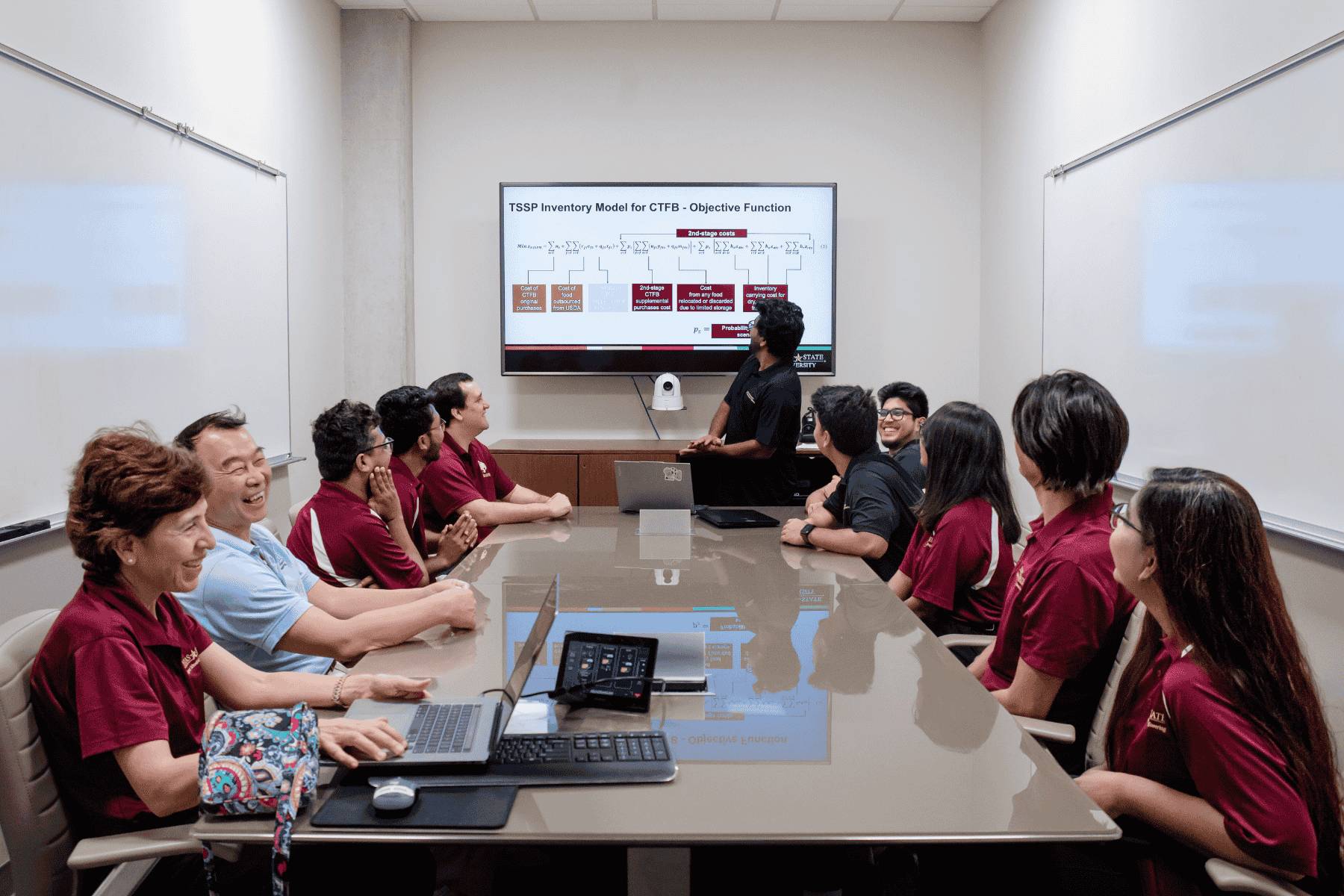
Program Overview
The program responds to the market's need for more industrial engineers with advanced degrees to solve industry and business operations problems in traditional and novel industrial engineering domains. Students will align their interests with a curriculum that emphasizes data science, machine learning, predictive analytics, prescriptive analytics, systems engineering, quality and reliability engineering, sustainable operations, and resilient supply chains. Through the completion of a thesis, students will develop cutting-edge experience in data-driven modeling, large-scale problem-solving, and statistical analysis to optimize industry and business operations.
Course Work
The coursework augments knowledge in industrial engineering and refines analytical, mathematical, computational, and communication skills. Students will complete required courses in five core areas: advanced statistical design of experiments, modeling and analysis of manufacturing systems, advanced quality and reliability engineering, applied deterministic operations research, and advanced heuristic optimization. The program also offers a wide range of prescribed electives to deepen students’ knowledge in seven areas: data science, machine learning, predictive analytics (e.g., statistical time series analysis and forecasting), prescriptive analytics (e.g., optimization and simulation), systems engineering, sustainable operations and resilient supply chains.
The open elective course prepares students for future multi-disciplinary professional careers involving information systems, engineering management, or computer science fields. The culminating research activity is the completion of a thesis, which enables students to develop cutting-edge experience in solving large-scale problems in an industry or business setting. Students have the opportunity to present their research at internal symposiums, regional conferences, local conferences or prestigious national conferences such as the IISE Annual Conference & Expo and the INFORMS Annual Meeting.
| Degree | Hours | Thesis Option | Location |
|---|---|---|---|
Degree M.S. | Hours 31 | Thesis Option Thesis | Location San Marcos |
BS/MS Combined Program
This program offers a combined program that allows students to earn both a bachelor of science in industrial engineering and a master of science in industrial and business operations engineering. The combined program consists of 117 hours of undergraduate coursework and 31 hours of graduate coursework (148 total hours), with 12 graduate hours applied toward the undergraduate degree. Texas State University undergraduate industrial engineering students are eligible to apply for admission to the program at the end of their junior year.
| Undergraduate Degree | Graduate Degree | Hours | Thesis Option | Location |
|---|---|---|---|---|
Undergraduate Degree B.S. in Industrial Engineering | Graduate Degree M.S. in Industrial and Business Operations Engineering | Hours 148 | Thesis Option Thesis | Location San Marcos |
Program Details
This program enables students to develop cutting-edge knowledge in industrial engineering and operations research, as well as advance project management, leadership, technical writing, and professional communication capabilities.
Program Mission
The educational objectives in this program include:
- preparing students to apply advanced knowledge in statistical design of experiments, simulation, optimization, and quality & reliability engineering to solve large and complex practical problems arising in industry and business operations
- preparing students to conduct multi-disciplinary research in the areas of industrial engineering, operations research, and systems engineering
- preparing students to effectively analyze, synthesize, communicate, and defend results that address the solutions to practical industrial and business operations problems
Career Options
Positions typically requiring a master’s in the industrial engineering field:
- supply chain analysts
- operations engineers
- operations research analysts
- data scientists
- senior manufacturing engineers
- industrial engineering or process improvement managers
- consultants
- project managers
- lecturers
Program Faculty
The program's faculty bring strong research backgrounds in data science, machine learning, quality and reliability engineering, systems engineering, design of experiments, forecasting, simulation, queueing models, stochastic processes, and optimization (e.g., linear, nonlinear, stochastic, dynamic, multi-objective, and heuristic).
In addition, faculty research areas span traditional and novel applications domains, including: smart manufacturing, digital twins, sustainable operations, resilient supply chains, net-zero manufacturing, transportation electrification, space logistics, supply chain optimization, renewable energy, disaster logistics, healthcare engineering and service systems engineering.
Faculty publish in top journals in the field, including International Journal of Production Research, Quality and Reliability Engineering International, European Journal of Operations Research, Journal of Cleaner Production, Simulation, Health Care Management Sciences, and Computers & Operations Research.
Faculty research is sponsored through grants and contracts from industry and federal organizations such as Toyota Material Handling, Texas Workforce Commission, Electric Power Research Institute, Department of Energy, National Science Foundation, Department of Homeland Security, Department of Health and Human Services (DHHS), US Department of Agriculture (USDA), and Oakridge National Labs.
Contact us for general questions about your application, funding opportunities, and more. If you have specific questions after reviewing the program details, contact the program's graduate advisor.

Already know that Texas State is right for you?
Application Deadlines
| DEADLINES | U.S. CITIZEN | INTERNATIONAL |
|---|---|---|
DEADLINES Fall - Priority | U.S. CITIZEN February 1 | INTERNATIONAL February 1 |
DEADLINES Fall - Standard | U.S. CITIZEN August 1 | INTERNATIONAL June 1 |
Priority Deadline: Ensures full consideration for admission and eligibility for certain funding opportunities, including scholarships, fellowships, and assistantships, and guarantees that your application will be considered in the initial review.
Standard Deadline: Represents the last day a complete application can be submitted, but does not guarantee admission consideration. After the priority deadline, applications are reviewed on a rolling, space-available basis until the program is full, at which point, applications will close.
For important information regarding deadlines and decision timelines, review the Graduate Admission Policies page.
Admission Requirements
The items required for admission consideration are listed below. Further details on individual requirements can be found on our admission policy page. Additional information for applicants with international credentials can be found on our international webpages.
-
Application
- completed online application
-
Application Fee
- $55 nonrefundable application fee, OR
- $90 nonrefundable application fee for applications with international credentials
-
Transcripts & GPA
- Baccalaureate degree in industrial engineering, computer science, mathematics, mechanical engineering, or a closely related field from a regionally accredited university. (Non-U.S. degrees must be equivalent to a four-year U.S. Bachelor’s degree. In most cases, three-year degrees are not considered. Visit our International FAQs for more information.)
- A copy of an official transcript from each institution where course credit was granted.
- A 2.75 overall GPA or a 2.75 GPA in the last 60 hours of undergraduate course work (plus any completed graduate courses).
- Non-credit (leveling) course work may be required prior to admission into the program if the student lacks sufficient background course work. Any required leveling course work must be completed with grades of B or better prior to admission.
-
Test Scores
GRE
- Official GRE (general test only) with competitive scores in the verbal reasoning, quantitative reasoning, and writing sections will be required. Texas State University students are exempt from this requirement.
Approved English Proficiency Exam Scores
Applicants are required to submit an approved English proficiency exam score that meets the minimum program requirements below unless they have earned a bachelor’s degree or higher from a regionally accredited U.S. institution or the equivalent from a country on our exempt countries list.
- official TOEFL iBT scores required with a 78 overall
- official PTE scores required with a 52 overall
- official IELTS (academic) scores required with a 6.5 overall and minimum individual module scores of 6.0
- official Duolingo scores required with a 110 overall
- official TOEFL Essentials scores required with an 8.5 overall
This program does not offer admission if the scores above are not met.
-
Documents & Other Requirements
- resume/CV detailing prior work experience, research experience, awards, scholarships, and other related qualifications
- statement of purpose (two pages) conveying research interests, plans for graduate study, and professional aspirations
- two letters of recommendation from non-related individuals familiar with the student’s scholarly work and/or relevant work experience