

Students learn to analyze and apply healthcare data using electronic health records, data science, and analytics tools. The program allows students to develop skills bridging clinical and technical concepts, applying statistical methods and informatics principles to improve patient care, support evidence-based decisions, and strengthen healthcare organizations.
Health Informatics
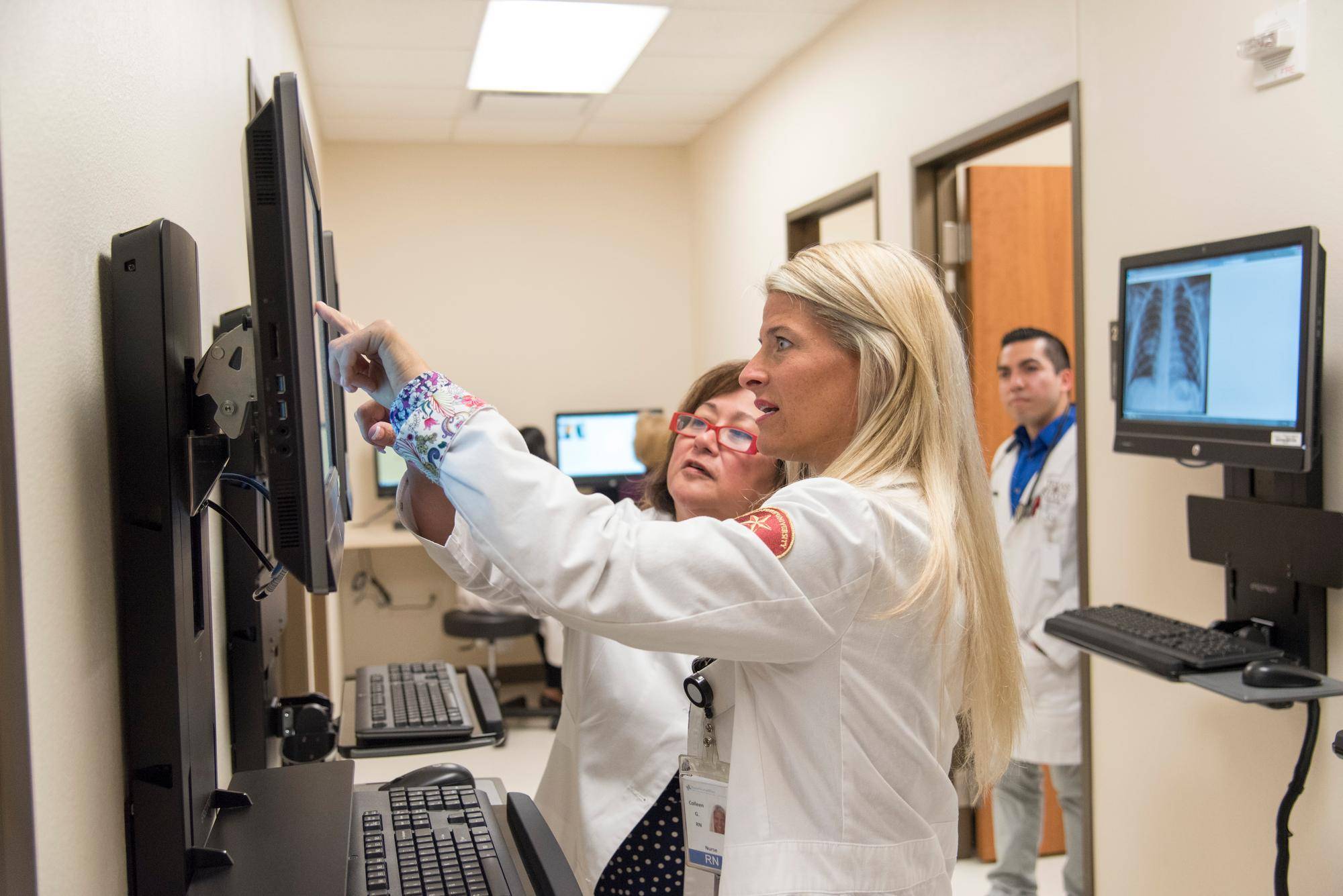
Program Overview
This program equips graduates with the analytical, technical, and leadership competencies needed to design, implement, and manage health information systems that improve patient care and organizational performance.
Course Work
Students complete 30 hours of graduate coursework consisting of 10 three-hour courses. An introductory first course includes orientation for all new students while the subsequent sequence of courses develops deeper health informatics knowledge and skills. In the last semesters of the program, advanced courses build on previous lessons to provide capstone projects that validate student mastery of the competencies. The competencies covered in the program help students prepare for highly regarded industry certifications offered by the American Medical Informatics Association (AMIA), the Healthcare Information and Management Systems Society (HIMSS), and other related professional organizations.
Core coursework covers healthcare data analytics, database management, health information systems, data privacy and security, project management, systems analysis, and clinical decision support. Students complete projects that apply their knowledge to real-world informatics challenges and demonstrate required competencies.
| Degree | Hours | Location |
|---|---|---|
Degree M.S. | Hours 30 | Location Online |
For more information on online programs, certifications, and international restrictions, visit our Graduate Admission Policies page.
Program Details
The health informatics program prepares students to apply knowledge and skills in healthcare data and technology to improve outcomes for patients, families, providers, and organizations. During the program, students learn to incorporate and apply health science, data science, project management, health data standards, and artificial intelligence. Graduates with a master’s in health informatics are in high demand across hospitals, tech firms, and government agencies to help translate clinical needs into effective information systems. Recognized for their leadership, teaching, and scholarship, faculty members actively collaborate across disciplines to drive innovation in healthcare information systems.
Program Mission
The M.S. in health informatics prepares professionals to transform healthcare through the effective use of data, technology, and information systems. Students develop and expand analytical, technical, and leadership skills that integrate health science, data science, and information technology. Through rigorous, evidence-based education, our graduates advance patient care, improve health outcomes, strengthen data privacy and security, and improve the efficiency of healthcare delivery.
The program is designed to enable graduates to:
- apply data analytics, statistical methods, artificial intelligence, and informatics principles to support evidence-based decision-making
- leverage electronic health records (EHR), databases, clinical and administrative information systems effectively
- ensure compliance with data privacy, security, and regulatory standards
- lead system implementation, project management, and quality improvement initiatives
- apply artificial intelligence responsibly
- bridge clinical practice and technology through interprofessional collaboration
Career Options
Graduates with a master of science in health informatics are found in numerous roles bridging healthcare and technology. Some health informatics professionals work in direct patient care while others focus on data and technology. Common positions include clinical informatics specialist, health data analyst, EHR implementation manager, health informatics consultant, and chief medical or nursing informatics officer. Other options include population health analytics, healthcare data architecture, interoperability, or clinical decision-support design. Employers span hospitals, payers, government agencies, pharmaceutical firms, and health-tech companies. Strong demand exists for professionals skilled in data analytics, privacy and security, artificial intelligence, and translating clinical needs into effective information systems.
Program Faculty
The Health Informatics and Information Management Department faculty have excellent experience and credentials that distinguish our programs from all others. The faculty members are committed to ethical, interprofessional, and innovative approaches that meet the evolving needs of healthcare organizations and communities. TXST faculty conduct research and develop scholarly products in many related areas, including health informatics, electronic health records, health data analytics, artificial intelligence in healthcare, health data privacy and cybersecurity, compliance, information governance, interprofessional education, health disparities, healthcare finance, health data quality, health literacy and communication strategies, and usability of health information systems. Faculty members collaborate frequently with colleagues from other disciplines and universities to publish in leading academic journals and textbooks. They are strongly engaged with professional organizations at local, state, national, and international levels. Many faculty members have received prestigious awards for their teaching, research, service, and professional leadership.
Contact us for general questions about your application, funding opportunities, and more. If you have specific questions after reviewing the program details, contact the program's graduate advisor.

Already know that Texas State is right for you?
Application Deadlines
| Term | Part of Term | Deadline | Start Date |
|---|---|---|---|
Term Fall | Part of Term First 8 Weeks | Deadline August 5 | Start Date August 19 |
Term Fall | Part of Term Second 8 Weeks | Deadline September 24 | Start Date October 8 |
Term Spring | Part of Term First 8 Weeks | Deadline January 4 | Start Date January 19 |
Term Spring | Part of Term Second 8 Weeks | Deadline February 23 | Start Date March 9 |
Term Summer | Part of Term First 8 Weeks | Deadline May 17 | Start Date June 1 |
For important information regarding deadlines and decision timelines, review the Graduate Admission Policies page.
Admission Requirements
The items required for admission consideration are listed below. Further details on individual requirements can be found on our admission policy page. Additional information for applicants with international credentials can be found on our international webpages.
-
Application
- completed online application
-
Application Fee
- $55 nonrefundable application fee, OR
- $90 nonrefundable application fee for applications with international credentials
-
Transcripts & GPA
- Baccalaureate degree (or equivalent) from an accredited college or university. (Non-U.S. degrees must be equivalent to a four-year U.S. Bachelor’s degree. In most cases, three-year degrees are not considered. Visit our International FAQs for more information.)
- A copy of an official transcript from each institution where course credit was granted
- A 2.75 overall GPA or a 2.75 GPA in your last 60 hours of undergraduate course work, plus any completed graduate courses.
-
Test Scores
GRE
- GRE not required
Approved English Proficiency Exam Scores
Applicants are required to submit an approved English proficiency exam score that meets the minimum program requirements below unless they have earned a bachelor’s degree or higher from a regionally accredited U.S. institution or the equivalent from a country on our exempt countries list.
- official TOEFL iBT scores required with a 78 overall if taken on or before January 21, 2026
- official TOEFL iBT scores required with a 4 overall if taken after January 21, 2026
- official PTE scores required with a 52
- overall official IELTS (academic) scores required with a 6.5 overall and minimum individual module scores of 6.0
- official Duolingo scores required with a 110 overall
- official TOEFL Essentials scores required with an 8.5 overall
- official Texas State Intensive English Program score of 90% or higher in the highest-level course (level 5)
This program does not offer admission if the scores above are not met.
-
Documents
- resume/CV
- statement of purpose indicating the student’s ability and interest in completing the degree program
- three letters of recommendation from professionals or academics assessing the student’s readiness to advance in the field