

Students learn to think critically, communicate effectively and apply their anthropological expertise to issues of global concern.
Anthropology

Program Overview
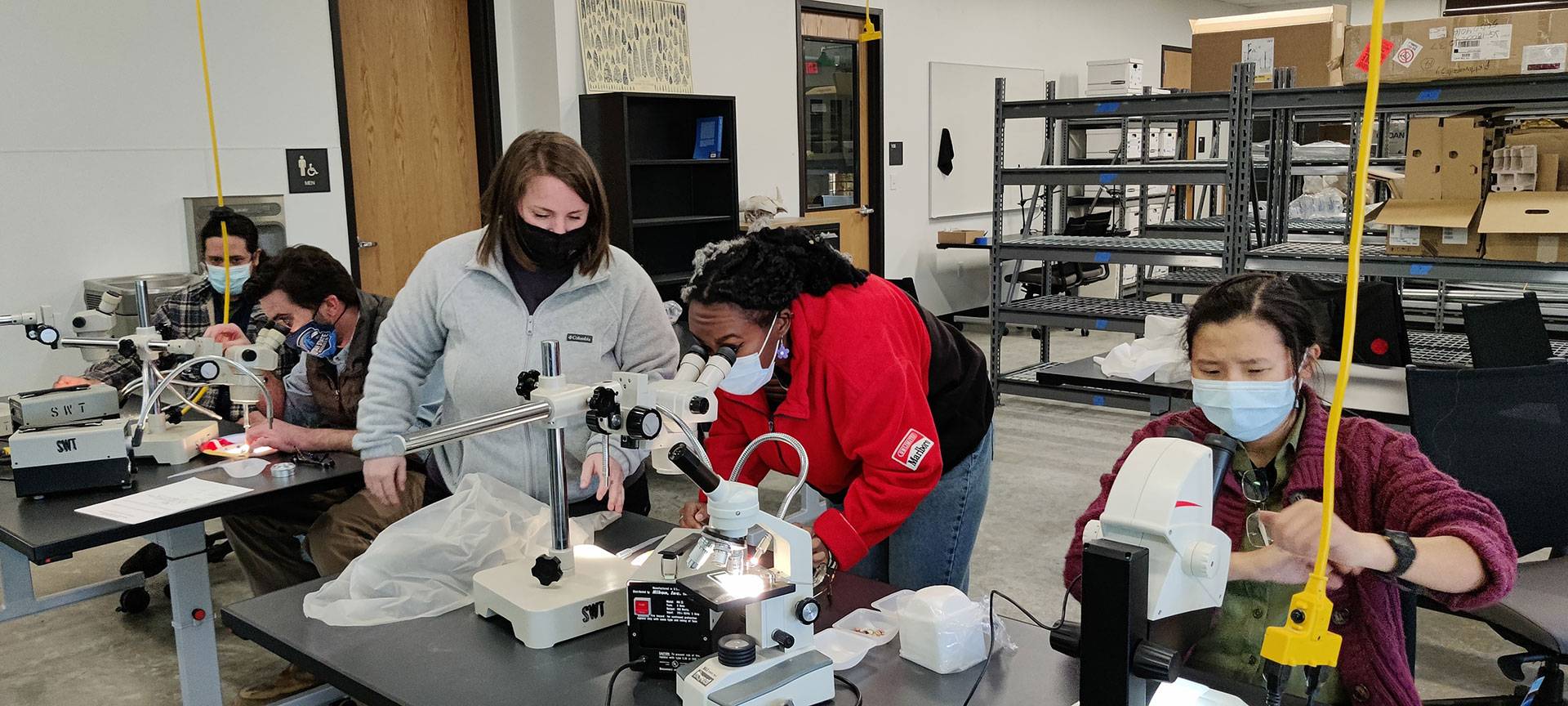
The Department of Anthropology at Texas State prepares anthropology graduate students for their future endeavors. Anthropology students regularly take part in field schools and internships, collaborate with faculty on research projects, work with professionals on applied projects, present their research at professional conferences, and publish their work in academic journals.
Course Work
Students complete 36 credit hours, which include seminars in archaeology, biological anthropology, and cultural anthropology; coursework in data collection and analysis; and electives appropriate to their sub-discipline. The department offers thesis and non-thesis options.
| Degree | Concentration | Hours | Areas of Research |
|---|---|---|---|
Degree M.A. | Concentration Archaeology | Hours 36 | Areas of Research Hunter-gatherers, complex societies, iconography, ceramic and lithic analysis, Native American ethnohistory, paleoenvironment, geoarchaeology, experimental archaeology, and cultural resource management |
Degree M.A. | Concentration Biological Anthropology | Hours 36 | Areas of Research Modern human skeletal variation, bioarchaeology, paleopathology, forensic anthropology, primate behavioral ecology and conservation |
Degree M.A. | Concentration Cultural Anthropology | Hours 36 | Areas of Research Medical anthropology, anthropological theory, political economy, globalization, race and gender, Latino culture, linguistics, phonetics, sociolinguistics |
Program Details
The M.A. in anthropology at Texas State provides students with the solid foundation they need to become professional anthropologists.
At TXST, the Department of Anthropology is transcending the borders that divide us and restrain us - whether that's transnational borders, disciplinary borders, or the borders between academic and practicing anthropologists. Our research and learning engage theoretically grounded, evidence-based, applied, public, and creative anthropologies to make impacts beyond the borders of anthropology. The mission of the M.A. in anthropology is to educate and train students to become professional, practicing anthropologists in the 21st century.
Career Options
Graduates of the program have successfully achieved professional careers in the corporate and business sector, public agencies, and non-profit and community-based organizations. Graduates have also successfully entered and completed top-tier doctoral programs.
Faculty in the department conduct research across the world, in the U.S., and locally in Texas. Faculty regularly include anthropology students in their research and mentor them as they pursue their own projects.
The department also hosts the Center for Archaeological Studies, the Forensic Anthropology Center, and the InnoAnth Lab, all of which provide hands-on educational opportunities and training to ensure anthropology students have marketable skills for employment and/or the skills to continue their education in a doctoral program.
Contact us for general questions about your application, funding opportunities, and more. If you have specific questions after reviewing the program details, contact the program's graduate advisor.
Already know that Texas State is right for you?
Application Deadlines
| DEADLINES | U.S. CITIZEN | INTERNATIONAL |
|---|---|---|
DEADLINES Fall - Priority | U.S. CITIZEN January 1 | INTERNATIONAL January 1 |
DEADLINES Fall - Standard | U.S. CITIZEN August 1 | INTERNATIONAL June 1 |
Priority Deadline: Ensures full consideration for admission and eligibility for certain funding opportunities, including scholarships, fellowships, and assistantships, and guarantees that your application will be considered in the initial review.
Standard Deadline: Represents the last day a complete application can be submitted, but does not guarantee admission consideration. After the priority deadline, applications are reviewed on a rolling, space-available basis until the program is full, at which point, applications will close.
For important information regarding deadlines and decision timelines, review the Graduate Admission Policies page.
Admission Requirements
The items required for admission consideration are listed below. Further details on individual requirements can be found on our admission policy page. Additional information for applicants with international credentials can be found on our international webpages.
-
Application
- completed online application
-
Application Fee
- $55 nonrefundable application fee, OR
- $90 nonrefundable application fee for applications with international credentials
-
Transcripts & GPA
- Baccalaureate degree from a regionally accredited university. (Non-U.S. degrees must be equivalent to a four-year U.S. Bachelor’s degree. In most cases, three-year degrees are not considered. Visit our International FAQs for more information.)
- A copy of an official transcript from each institution where course credit was granted.
- A 3.0 overall GPA or a 3.0 GPA in your last 60 hours of undergraduate course work (plus any completed graduate courses).
-
Test Scores
GRE
- GRE is not required
Approved English Proficiency Exam Scores
Applicants are required to submit an approved English proficiency exam score that meets the minimum program requirements below unless they have earned a bachelor’s degree or higher from a regionally accredited U.S. institution or the equivalent from a country on our exempt countries list.
- official TOEFL iBT scores required with a 78 overall if taken on or before January 21, 2026
- official TOEFL iBT scores required with a 4 overall if taken after January 21, 2026
- official IELTS (academic) scores required with a 6.5 overall and minimum individual module scores of 6.0
- official Duolingo scores required with a 110 overall
- official TOEFL Essentials scores required with an 8.5 overall
This program does not offer admission if the scores above are not met.
-
Documents
- resume/CV
- statement of purpose detailing your academic interests in one of the concentrations and identifying possible areas of anthropological research. If applicable, include any crossover areas of research from the other anthropological concentrations.
- three letters of recommendation